Empa Young Scientist Fellowship 2026
Nanoscale Mechanics of Amorphous/Amorphous Nanolaminates
Empa Young Scientist Fellowship Proposal 2026
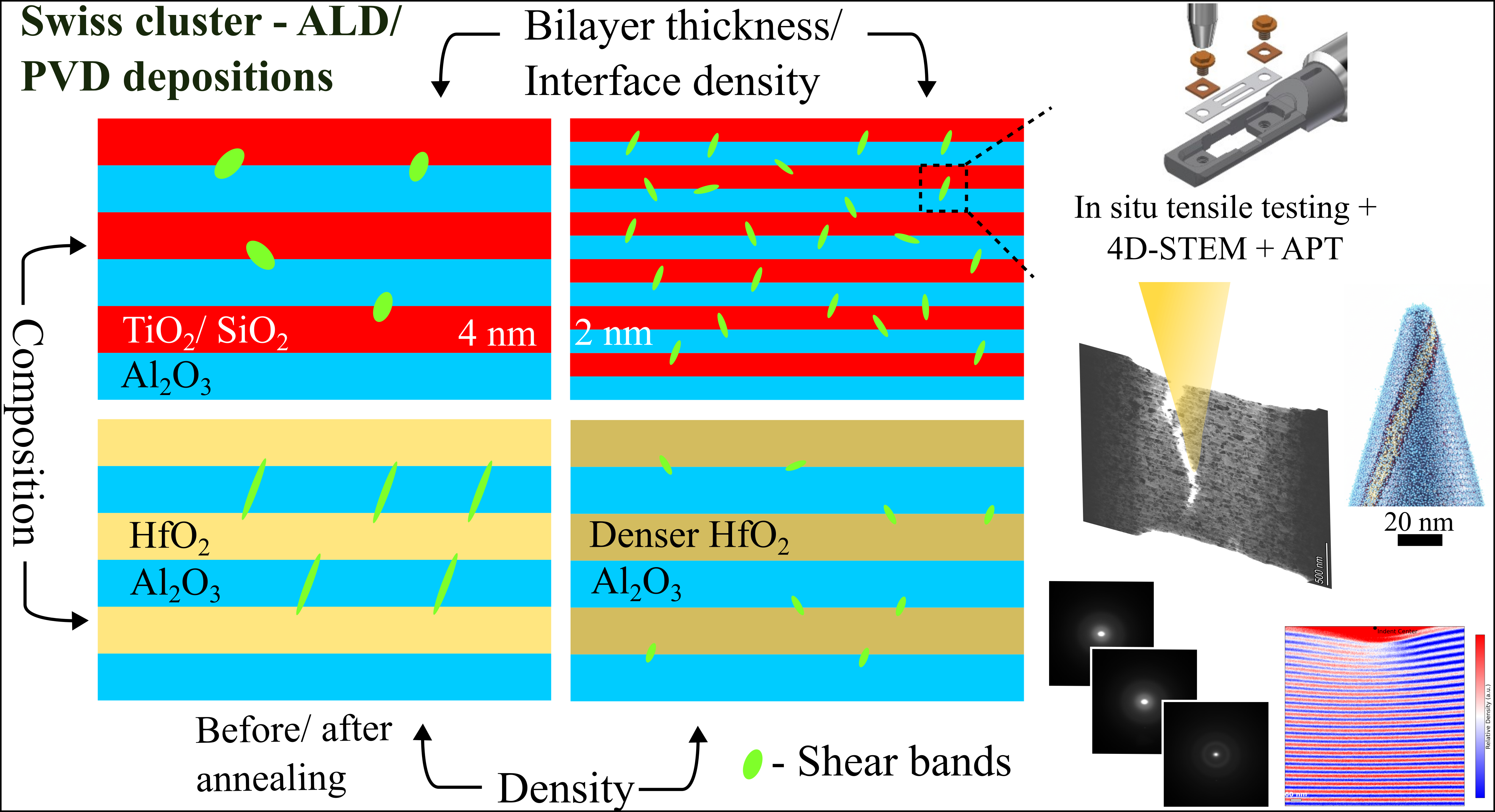
Key project ideas: Generate a library of A/A thin films using the 'Swiss cluster' and mechanically test them at nanoscale
Why This Project Matters
Amorphous/amorphous (A/A) nanolaminates are everywhere—from transistors in your smartphone to antireflective coatings on your glasses. This represents a multi-billion dollar commercial market. Yet, despite their widespread use, we have limited understanding of how these materials deform and fail at the nanoscale.
The Problem: Without understanding deformation mechanisms, we cannot predict failure, optimize design, or develop next-generation materials.
The Solution: This project will use cutting-edge in situ TEM with 4D-STEM to directly observe and quantify nanoscale deformation mechanisms in real-time.
Key Research Questions
- How do A/A interfaces accommodate strain without crystalline defects like dislocations?
- What mechanisms operate when traditional plasticity is absent?
- What causes failure in commercially relevant A/A nanolaminates?
- Critical insights for reliability and lifetime prediction
- Can we design tougher A/A systems by understanding interface mechanics?
- Structure-property relationships for material optimization
Research Approach
🔬 In Situ TEM Mechanics
Direct observation of deformation and failure mechanisms under controlled loading
🎯 4D-STEM Analysis
Quantifying local strain fields and structural evolution at nanometer resolution
📊 Failure Analysis
Identifying critical mechanisms for commercially relevant A/A systems
💡 Design Guidelines
Developing structure-property relationships for material optimization
Frequently Asked Questions
Why does this research matter?
A/A nanolaminates are ubiquitous in technology—from microelectronics to optical coatings—representing a multi-billion dollar market. Yet their mechanical behavior remains poorly understood:
- Commercial Impact: Understanding failure mechanisms enables reliability predictions and extends device lifetimes
- Material Innovation: Knowledge of deformation mechanisms guides design of tougher, more resilient A/A systems
- Scientific Gap: No dislocations, no grains—how do these materials deform? This project will provide answers
What makes this approach unique?
- In situ + 4D-STEM: First time combination of real-time deformation with nanoscale strain mapping in A/A systems
- Commercially relevant materials: Focus on real industrial systems, not just model materials
- Direct mechanism identification: Move beyond post-mortem analysis to observe deformation as it happens
What are the expected outcomes?
- Deformation mechanism maps for A/A nanolaminates
- Failure prediction criteria for commercial systems
- Design guidelines for next-generation tough A/A materials
- High-impact publications and openly shared data
Why fund this project?
- High commercial relevance: Directly impacts multi-billion dollar industries
- Critical knowledge gap: Filling an important void in understanding industrially-important materials
- Novel methodology: First-of-its-kind combination of in situ TEM and 4D-STEM for A/A systems
- Practical outcomes: Failure analysis tools and design guidelines, not just academic papers
- Leverages Empa strengths: World-class TEM facilities and expertise in mechanical testing
My Commitment
This research proposal represents ideas I’m deeply passionate about and committed to executing. If funded, I will:
- Share Regular Updates: Document progress, challenges, and discoveries through this website
- Publish Openly: Make findings accessible through high-quality publications and open data
- Engage the Community: Present results at conferences and collaborate with other researchers
- Demonstrate Impact: Show how fundamental research translates to practical applications
This page will evolve into a project hub where I’ll share:
- Experimental results and insights
- Videos and animations of deformation mechanisms
- Data visualizations and analysis tools
- Publications and presentations
Why This Matters to Me
Understanding how materials deform at the nanoscale has been a central theme throughout my career. This project combines my expertise in advanced microscopy with my passion for connecting atomic-scale observations to real-world material behavior. I’m committed to making this research open, accessible, and impactful.
Contact
If you have questions about this research or are interested in collaboration opportunities, please feel free to reach out:
Email: vivek.devulapalli@empa.ch